
17 August, 2025
Tantalising Take-aways – a report on NZCA’s Annual Conference 2025
“Health and Well-being in Our Community” was the theme of this year’s New Zealand Chinese Association’s (NZCA) Annual Conference held on 12 and 13th July 2025 in Kilbirnie, Wellington. In this article, conference facilitator, Doris Sew Hoy, reports on the key messages from each of the four guest speakers.
It was an absolute pleasure and honour to facilitate this year’s Conference. Pleasure because it was so enjoyable and enlightening reconnecting with some old friends and acquaintances. And an honour as this was the first time NZCA has used a Conference facilitator. Together with NZCA’s national executive team, the programme agenda was designed with guest speakers addressing different aspects of the theme, interspersed with Annual General Meeting items
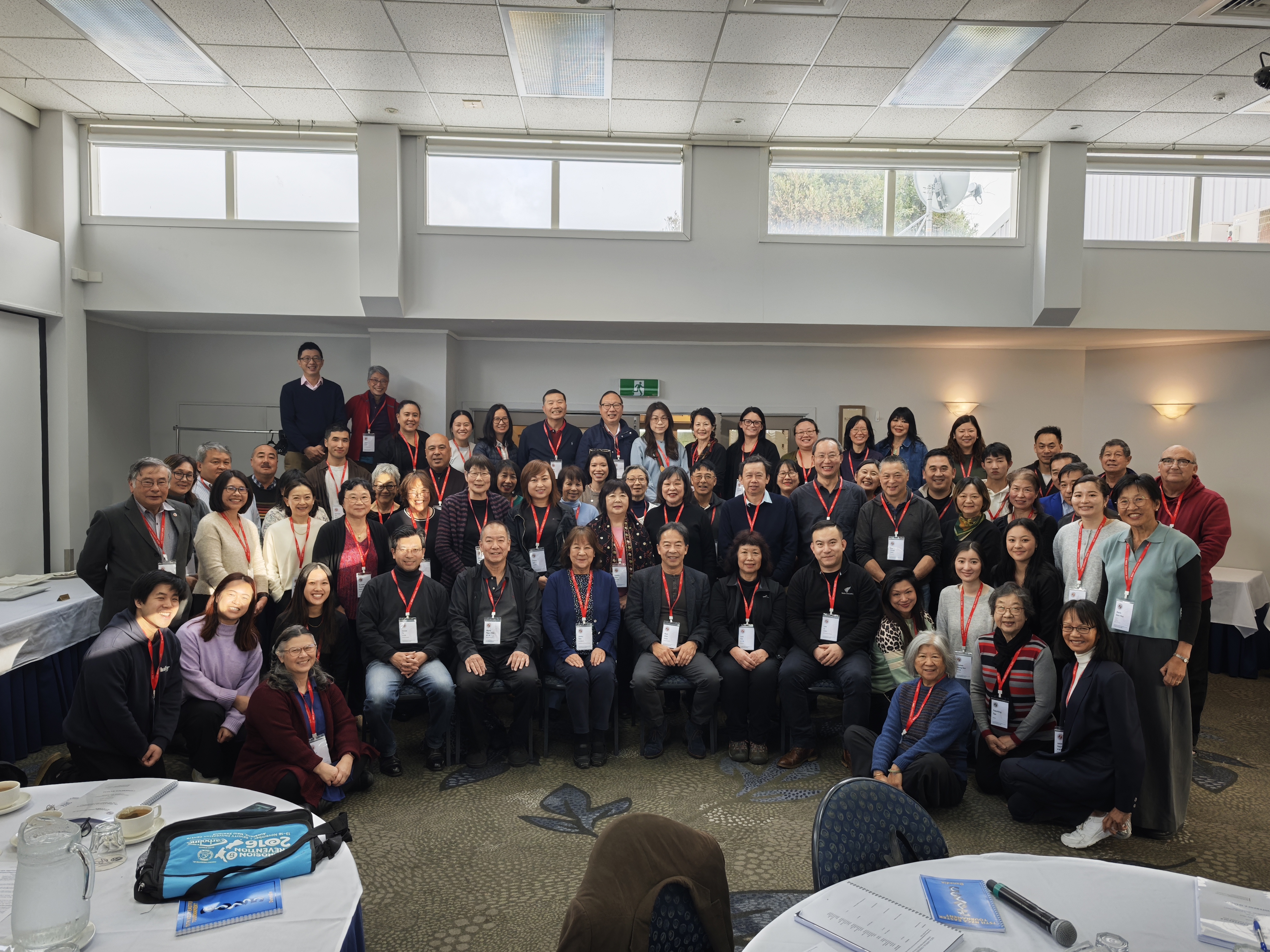
Held on the 12th and 13th July 2025 at the Brentwood Hotel in Kilbirnie, convenient to Wellington’s airport, this year’s Conference attracted a record attendance of over 70 delegates, with attendees from the three larger centres of Auckland, Wellington and Christchurch making up 40%.
NZCA’s national president, Paul Chin, opened proceedings with his vision for this year’s Conference. “I want this to be something different. I want it to be more engaging, more inclusive, more inter-active,” he told delegates. “And I want you to have something personal to take away for yourself, as well as ideas and information for your branch. This is your space. Space to learn, reflect and connect.”
Handing over to me as Conference facilitator, I had two objectives for this next introductory or ice-breaker-type session: 1) for delegates to get to know me, and 2) for them to get to know each other more. Given that over half the delegates have been coming to this annual event for many years now and were likely to know – or assume they know – quite a lot about each other, the session needed to be relevant and purposeful, as well as being fun and where people learn something that they didn’t know before. Based on feedback, I’m pleased to say that it went just the way I’d hoped.
Managing state and better conversations
As well as my role as Conference facilitator, I had the privilege of being the first guest speaker. I ran a workshop on managing one’s mental or internal state and how to have better conversations. The session aimed to give delegates an experience that would be useful at a personal level.
After the tea break, delegates were encouraged to sit next to someone they didn’t know and would like to get to know more. Then, working in pairs, delegates went through a series of exercises to give them the experience of being listened to without being interrupted. They were also introduced to some simple question structures that could encourage speakers to say more about what they were talking about.
Several people remarked how valued they felt being listened to, as well as how difficult it can be to listen without interrupting. Being able to pay exquisite attention, listening actively and mindfully, to the speaker and to the words actually spoken, is a critical skill contributing to better conversations and better connections. And like any skill, it can be learned and developed if one has the desire and determination to do so. Hopefully, this was something delegates could take away and start practicing immediately.
Identity and social cohesion
The second guest speaker was Dr. Melissa Derby, NZ’s Race Relations Commissioner, who was appointed last year. She gave an overview of her role within the Human Rights Commission, followed by some useful statistics and facts to give a snapshot of the NZ Chinese community today.
According to the 2023 Census, NZ Chinese account for 5.6% (279,037) of NZ’s total population, with most (69%) living in the Auckland region, followed by Canterbury (9%), Wellington (8%) and Hamilton (4%). I was intrigued to learn that a large majority of NZ Chinese (71%) were born overseas, with over half having lived in NZ for 10 years or more. This means that the identity of Chinese New Zealanders is not homogeneous and encompasses a very wide ethnic mix with multiple sites of belonging – quite different from NZCA’s traditional roots of predominately Cantonese speakers from Guangdong region.
As Race Relations Commissioner, Melissa is committed to ensuring the rights of all groups in NZ are upheld, and to promote harmonious relations through open dialogue and common connections. An advocate of the power of storytelling, she urged delegates to share their own stories as Chinese New Zealanders so that the diversity of personal narratives can contribute to building greater social cohesion across NZ’s multi-ethnic communities.
Resilience and perseverance
Our third guest speaker was 20-year-old student-athlete and world-class rhythmic gymnast Paris Chin from Christchurch. Delegates’ introduction to Paris was a short video clip of her breath-taking performance at the 2022 Commonwealth Games in Birmingham, UK. She was the youngest athlete in Team NZ, and the first Chinese-Kiwi female gymnast to represent NZ at a major sporting event.
Currently in her second year of full-time studies towards a BA Honours degree in Strategic Communications and International Relations at University of Canterbury, Paris trains for four hours in the morning, and four hours each afternoon. How does she manage studying and so much training?
“I guess I just know what I want, and I know what I have to do to get there,” she tells us, simply. “When I get tired of studying, I like to do the training. I think both complement each other. Juggling life isn’t always easy. I’m lucky to have a strong support system that helps me stay grounded.”
She made it sound so straight-forward! But no doubt, huge amounts of dedication, perseverance and resilience are required. I asked her about the challenges she faced. “I also have a part-time job as I need to raise funds for travel and competitions, which are mostly overseas. Rhythmic gymnastics in NZ is low priority for funding by sports bodies and government, unlike popular sports like rugby or cricket. And sometimes I get injured and need time to recover.”
Paris’s dream is to compete at the 2028 Olympic Games in Los Angeles. To be selected, she needs to win the Oceanic Championship in 2026. We wish her every success, and hopefully, NZCA and its branches might be able to help.
Our Chineseness – superpower or kryptonite?
Our fourth and final guest speaker was Antony Young, a globally experienced media executive, entrepreneur, and CEO leading marketing agencies across New York, London, Asia and New Zealand including Saatchi & Saatchi and ZenithOptimedia. In a highly illustrative and entertaining speech, he gave delegates candid insights into his professional life and the impact of its “success” on his personal and family life and well-being. After 20 years abroad, he made the difficult decision to walk away and return to New Zealand to start a new chapter, one which saw him bring balance into his life. “I started prioritising the things that feed me emotionally, mentally and physically,” he said, “And life got a whole lot richer.”
Antony inspired delegates to reflect on their own life and what it means to be Chinese. He admitted that when he was growing up, he didn’t really think too much about being Chinese. However, his experience working overseas has made him much more aware of his “Chineseness”.
“Chineseness is our superpower,” he told delegates, and went on to explain what being Chinese meant for him, like the habits we have, such as fighting to pay the bill after going out for dinner, taking off our shoes at the entrance of a house, boiling our drinking water, our love of food and eating. But he warned delegates that our Chineseness can also be our kryptonite, something that can take us down or blow us up. For example, typical Chinese traits like quietly working away and hoping our work will speak for itself. “But often as Chinese, we can be overlooked for promotions. In business, no one cares how hard you work. They care what you bring. Selling ourselves short is kryptonite.”
In closing, Antony offered some ideas for everyone to consider. “As Chinese, we should help and support other Chinese more. And we should also ask ourselves, what could we do to make an impact to the wider NZ community. Is there something we could do to make Aotearoa New Zealand a better, more tolerant place? What can we do to be more relevant to the wider, multi-ethnic communities beyond Chinese?”
Tantalising takeaways
In addition to receiving a very elegant pair of Commemorative Chopsticks at the banquet held on the Saturday evening to celebrate NZCA’S 90th anniversary, hopefully all delegates were able to take away some useful ideas to improve health and well-being at a personal and community level. Thanks to input from guest speakers, as well as the lively discussions on AGM matters, fresh energy and enthusiasm has been injected to forge NZCA’s future.
Looking at the card that came with the Commemorative Chopsticks, I see that they are “a memento symbolising family, teamwork, and Chinese tradition. They represent harmony, unity, and togetherness. As a pair, they remind us that great things are achieved when we work side by side.” This token certainly reflects the spirit of connection and culture which NZCA proudly shares.
I’m wondering how we, and NZCA as an entity, can better articulate what is meant by “Our Community”. How can we better embrace the many diverse Chinese groups that make up New Zealand Chinese, and the wider multi-ethnic communities within Aotearoa New Zealand generally? Perhaps that’s a theme for next year’s Conference.
_______________________________________________________________________________
Notes:
NZCA, established in 1935, is Aotearoa’s oldest incorporated society representing Chinese people in the country. The Annual Conference includes the AGM, and attendance is restricted to members only – i.e. representatives of the 14 “branches” of the NZCA, each covering a geographic region from Auckland in the north to Otago/Southland in the south. Each branch is run by a team of volunteers who promote, organise and support local initiatives and events for their branch members.
Turning Stone into Jade: The History of the New Zealand Chinese Association, by David Fung, published in 2014 provides comprehensive information chronicling NZCA’s formation and development.
Doris Sew Hoy is an accredited executive coach and Clean Language group facilitator. She is the author of Trust Yourself First: Cultivating Self-Awareness, Confidence and Resilience, published in 2022. She was a guest speaker at NZCA’s Leadership Development Conference (LDC) in 2023.
Email: doris.lifeworks@gmail.com Website: https://www.dorissewhoy.com/
The New Zealand Chinese Association is a national organisation with over 80 years of uninterrupted history, comprising of 14 branches throughout New Zealand.
It represents the interests of both long-established and new Chinese migrant groups.
Latest Posts
- Easter 2026 7 April, 2026
- Easter 2019 7 April, 2026
- Easter 2018 7 April, 2026
Useful Links
2026 © All Rights Reserved.